


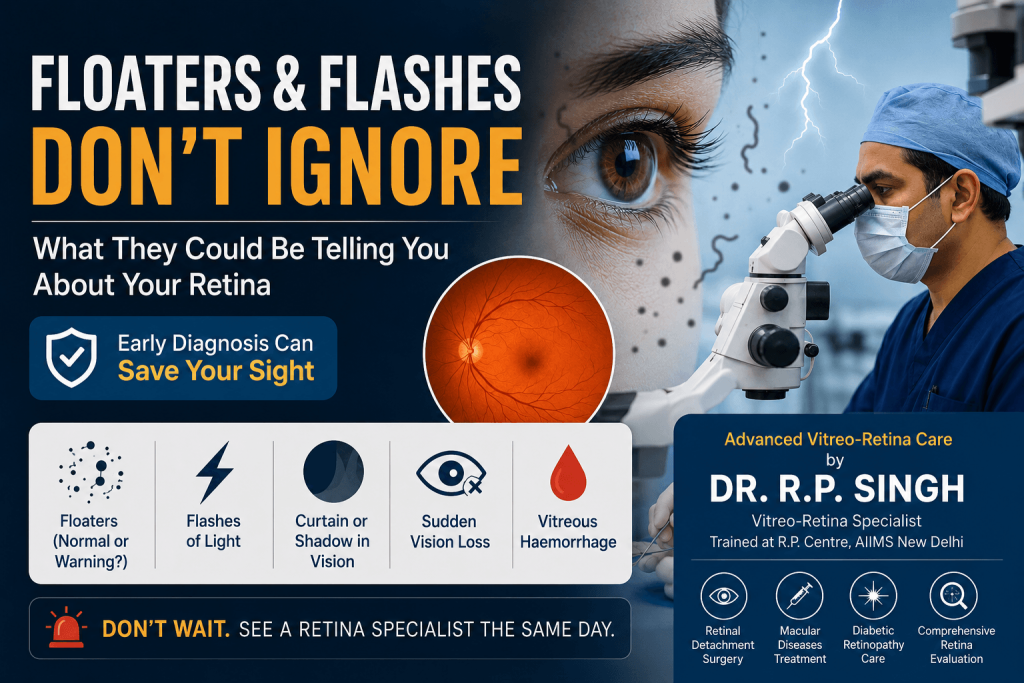
You are sitting at your desk when you suddenly notice a shower of black dots drifting across your vision. Then a flash of light at the edge of your eye — like lightning, but inside your head. Do you ignore it and wait for your next routine appointment, or do you rush to an emergency eye clinic?
The answer to that question could determine whether you keep your vision. Floaters and flashes can be completely harmless — or they can be the first sign of a retinal tear or detachment, which is a sight-threatening emergency requiring treatment within hours to days. Knowing the difference is something every Delhi resident should understand.
At Visitech Eye Centre, our Vitreo-Retina department — led by Dr. R.P. Singh, a superspecialist trained at R.P. Centre, AIIMS New Delhi — handles the full spectrum of retinal diseases, from routine diabetic eye screening to emergency retinal detachment surgery.
Table of Contents
Understanding the Retina and Vitreous
The retina is a thin, light-sensitive layer of tissue lining the back of the eye, roughly the size and thickness of a postage stamp. It converts light into electrical signals sent to the brain via the optic nerve — essentially acting as the ‘film’ of your camera.
The vitreous is the clear, gel-like substance filling most of the eyeball. It is firmly attached to the retina in several places, particularly near the optic disc and at the peripheral retina. As we age, the vitreous liquefies and shrinks — a normal process called posterior vitreous detachment (PVD) — pulling away from the retina. Usually harmless, but when it pulls too hard, it can tear the retina.
Floaters — When Are They Normal and When Are They Not?
Normal Floaters
Floaters are shadows cast by small clumps of gel, proteins, or cells within the vitreous. They drift when your eye moves and are most visible against a bright background like a blue sky or white wall. Occasional floaters that have been present for years and are not increasing are generally benign.
Warning Floaters — Seek Urgent Care
- A sudden shower or cloud of new floaters appearing out of nowhere
- Floaters accompanied by flashes of light (photopsia) — especially arc-like or peripheral flashes
- A dark curtain, shadow, or veil creeping across your vision from any direction
- Sudden loss of central or peripheral vision
- A reddish tinge to the vision (vitreous haemorrhage)
Emergency Rule: If you experience a sudden increase in floaters + flashes of light — see a retina specialist on the SAME DAY. A retinal tear, if treated within 24–48 hours with laser, can prevent a full detachment. Once the retina detaches, surgery is required, recovery is longer, and visual outcomes are less predictable.
Retinal Tear vs Retinal Detachment — What Is the Difference?
| Retinal Tear | Retinal Detachment | |
| What It Is | A break or hole in the retinal tissue | Retina has lifted away from the underlying layer (RPE) |
| Urgency | Urgent — treat within 24–48 hours | Emergency — treat within hours to days |
| Treatment | Laser photocoagulation (in-clinic, 15 minutes) | Vitrectomy surgery or scleral buckle |
| Outcome | Excellent — prevents detachment | Good if treated early; worse if macula is involved |
Retinal Detachment Surgery — What to Expect
At Visitech Eye Centre, retinal detachment is treated using one or more of these techniques, chosen based on the type and extent of detachment:
Pars Plana Vitrectomy (PPV / MIVS)
Minimally Invasive Vitreous Surgery (MIVS) is the primary approach for most retinal detachments. Using micro-instruments through tiny 0.5mm incisions, the vitreous gel is removed, the retina is flattened, and the break is sealed with laser. A gas bubble or silicone oil is used to tamponade the retina internally while it heals. Most patients are discharged the same day or within 24 hours.
Scleral Buckle
A silicone band is placed around the outside of the eye to gently indent the wall and bring it toward the detached retina. Often combined with vitrectomy for complex cases.
Pneumatic Retinopexy
A gas bubble is injected into the eye in the clinic, and the patient positions their head to allow the bubble to float against the detachment. Used for specific types of superior detachments.
Other Serious Retinal Conditions We Treat
Age-Related Macular Degeneration (AMD)
AMD affects the macula — the central, high-definition area of the retina — causing progressive central vision loss. Wet AMD involves abnormal blood vessel growth (neovascularisation) that bleeds and scars the macula rapidly. Treated with anti-VEGF intravitreal injections (Avastin, Lucentis, Eylea), which can stabilise and sometimes improve vision if started early.
Macular Hole
A small break in the macula that causes a central blank spot and distorted vision. Treated surgically with vitrectomy, membranepeel, and gas tamponade — with high success rates (>90%) when addressed promptly.
Epiretinal Membrane (Macular Pucker)
A thin fibrous membrane that grows over the macula, causing it to wrinkle and distort vision. Surgically peeled during vitrectomy. Vision improves gradually over 3–6 months post-surgery.
Vitreous Haemorrhage
Bleeding into the vitreous — from diabetic retinopathy, a retinal tear, or trauma — causing sudden, painless vision loss. If the blood does not clear spontaneously, vitrectomy is performed to clear it and treat the underlying cause.
Your Retinal Health Checklist
- Sudden increase in floaters or flashes → Same-day retina specialist visit
- Diabetic patients → Annual dilated retinal examination from time of diagnosis
- Anyone over 50 with central vision distortion → Urgent AMD evaluation (OCT scan)
- High myopia (over -6 diopters) → Peripheral retinal examination every 1–2 years
- Family history of retinal detachment → Baseline retinal examination
Dr. R.P. Singh’s Note: The retina does not give second chances. A retinal tear treated with a 15-minute laser in our clinic today can prevent a week-long surgical admission and months of recovery tomorrow. Please do not delay if you have new floaters with flashes.